Single Agent vs Multi-Agent: Build One That Works Before You Build a Team
The conference circuit says a team of agents. The research says otherwise. Here is what actually makes something an agent, why one is usually enough, and the honest signals that tell you when it is not.
Sit through enough conference talks and you would conclude that serious AI work means a team of agents — a researcher, a writer, a critic, a supervisor — passing work between themselves like a well-run department. It is a genuinely appealing picture. It is also, for most businesses in 2026, the wrong place to start.
The uncomfortable finding is that the sophisticated-sounding option is not reliably the better one. Most companies do not need a multi-agent system. They need one well-scoped agent that does one job dependably, and the discipline to resist adding parts before the simple version has been built and measured. That is not a beginner’s compromise you graduate from. On a large share of real business problems, it is the answer — and the industry’s own research increasingly backs that up, even as the conference circuit says otherwise.
This piece is for the technical lead or founder who has been pitched agents as an orchestration story and has not yet built anything. Here is what an agent actually is, why one is usually enough, and the honest signals that tell you when it is not.
First, what actually counts as an agent
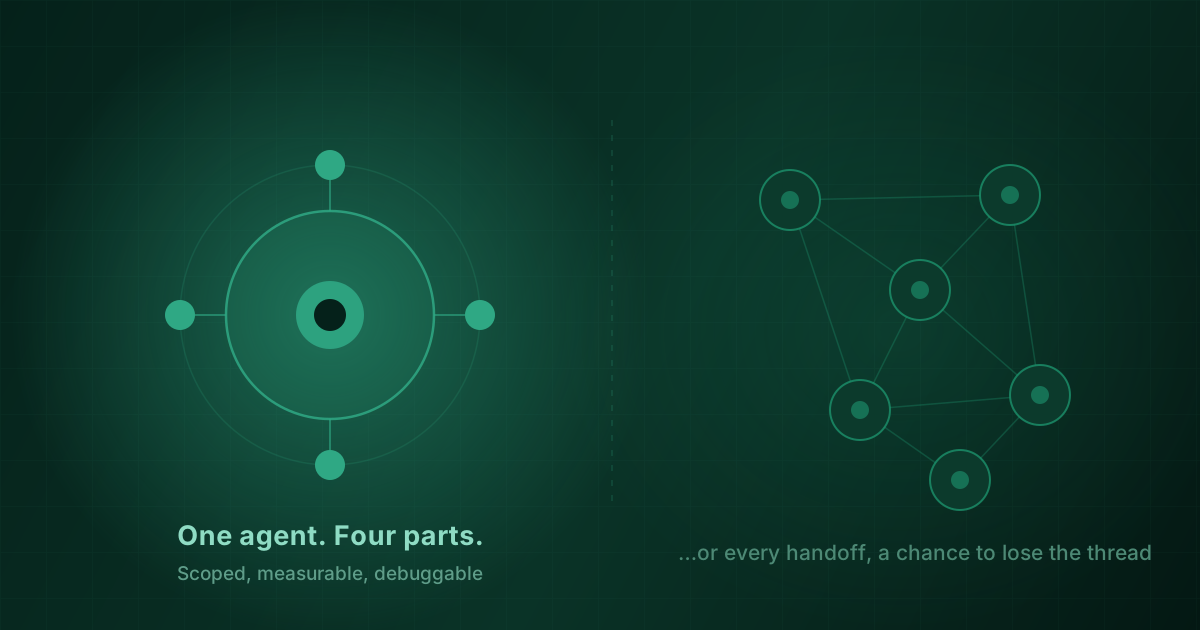
The word has been stretched to cover almost anything with a model in it, which makes honest conversation difficult. A useful, unfashionably strict definition: a working agent has four parts, and it needs all four.
There is a reasoning engine — the model deciding what to do next. There is a planning capability that breaks a goal into steps rather than answering in one shot. There is memory, so context carries forward instead of resetting. And there is a tool layer, letting it act on real systems rather than only producing text.
That bar is meaningfully higher than “a chatbot that can call an API,” and the distance between those two things explains a lot of quiet disappointment. A support bot that looks up an order status has reasoning and a tool. It has no planning, so it cannot handle a request that takes four steps. It has no memory, so it cannot build on yesterday. It will feel impressive in a demo and thin in production — not because the model is weak, but because two of the four parts were never built.
Get precise about this early. Most “our agent isn’t working” conversations turn out to be about a system that was never an agent to begin with.
The case for starting with one — and the evidence behind it
Almost everyone writing about this recommends starting simple. Microsoft’s own guidance says to move to multi-agent only when the task needs more context than one window can hold, or when subtasks need tool access that cannot safely coexist in one agent. That is sensible. It is also usually stated as received wisdom, without evidence.
The evidence arrived, and it is more pointed than the folk advice. Researchers at Stanford tested single-agent systems against several multi-agent architectures on multi-hop reasoning, across three model families, holding the thinking-token budget constant. When both sides got the same amount of reasoning to spend, the single agent consistently matched or beat the team.
The explanation is more interesting than the result. Every time work passes between agents, it gets summarized — and summarizing is lossy. A single agent holds one continuous line of reasoning with nothing thrown away at a handoff. Split the same problem across four agents and you have introduced three opportunities to drop the detail that mattered. The coordination you added to make the system smarter is the thing making it forget.
There is a cost argument sitting on top of the capability one. A single agent is cheaper to run, faster to iterate on, and dramatically easier to debug — when something goes wrong, there is one reasoning trace to read, not a conversation between four components to reconstruct. Industry analysis through 2026 consistently puts single-agent systems as the right fit for the large majority of enterprise use cases, at lower cost and lower complexity than the multi-agent alternative. Exact percentages vary by who is counting, so treat the number as a direction rather than a fact. The direction is not seriously contested.
What “well-scoped” actually means
“Start with one agent” is useless advice if the one agent is asked to do everything. Well-scoped has a specific meaning: one domain, one clear success criterion, one owner, and a small enough set of tools that you can reason about what the agent will do. Narrow enough, in short, that you can tell whether it worked.
Three examples of the shape:
- Support ticket triage. Read the incoming ticket, classify it, attach the relevant history, route it to the right queue. One domain. Success is measurable against what your team would have done, and wrong answers are cheap and visible.
- A research-brief generator. Given a topic, gather sources, extract the relevant points, produce a structured brief in a fixed format. Bounded inputs, bounded outputs, and a human reviews the result before it matters.
- A lead-qualification assistant. Take an inbound enquiry, enrich it from your CRM, score it against criteria you already use, flag the ones worth a human call. The criteria existed before the agent, which is exactly what makes the agent gradeable.
What these share is a real answer to “how would we know this is working?” before a line of code is written. That question, not the architecture, is what separates the agent projects that survive from the ones that quietly get shelved.
The number nobody puts on the slide
Two Gartner figures belong side by side, and they rarely appear that way. The first: 40% of enterprise applications are projected to include task-specific agents by the end of 2026, up from under 5% a year earlier. That is a genuinely fast adoption curve.
The second, from the same analysts: over 40% of agentic AI projects will be canceled by the end of 2027. The reasons Gartner gives are worth reading slowly — escalating costs, unclear business value, inadequate risk controls. Not one of them is “the models were not good enough.”
Other analyses point the same direction. Depending on how you define it, the share of enterprises running agents at genuine production scale sits somewhere between roughly 2% and the low teens, even while nearly everyone reports pilots. The gap is not enthusiasm. It is that pilots are graded on whether the demo impressed someone, and production is graded on whether the thing works on a Tuesday when the input is strange.
Signals you have genuinely outgrown one agent
None of this is an argument that multi-agent systems are a mistake. They solve real problems that one agent cannot, and the coordination question deserves its own treatment. It is an argument about sequence. These are the signals worth acting on — and note that they are observations from a running system, not predictions:
- The work genuinely spans three or more distinct domains, each with its own tools and its own idea of a good answer.
- Subtasks need tool access that cannot safely share one agent — the thing that reads customer records should not be the thing that can issue refunds.
- Compliance requires separate audit trails per function, so you can show who did what without untangling one combined trace.
- The context needed across the full workflow will not fit in one window, and you have already tried a real memory architecture rather than just stuffing history into the prompt.
- Parts of the work are genuinely independent and running them in parallel is the point, not a nice-to-have.
If your answer to all five is no, adding agents will add cost and debugging surface without adding capability. If two or three are clearly yes, you have earned the complexity — and you will design it far better having watched a single agent fail in specific, documented ways first. Those failure patterns are not a false start. They are the requirements document.
Where Macrosol fits
We are building an internal marketing agent at Macrosol Technologies, and it is deliberately a single-agent system — not because we could not build a multi-agent version, but because we could not yet justify one. It has a narrow domain, a defined set of tools, and a success criterion we can argue about honestly. When it fails, we can see why in one trace. If and when it outgrows that shape, the evidence for what to split will come from its own logs rather than from an architecture diagram we drew before we knew anything. That is the same discipline we bring to client work, where the useful question is usually not “how do we build agents” but “what is the smallest thing that would actually work here, and how would we know?” It sits alongside our broader AI & Data Science practice.
The honest answer
The reason this framing gets so little airtime is that it does not sell well. “Build one narrow agent and measure it carefully” is a worse keynote than an org chart of collaborating AI workers. But the research does not support the keynote, the cancellation rates do not support the keynote, and the teams quietly running agents in production mostly did the boring thing first.
Build the simple version. Instrument it properly. Let it tell you what it cannot do. If that evidence points to multi-agent, you will build a much better multi-agent system than you would have designed on day one — and if it does not, you have saved yourself a system you would have spent the next year debugging. Either way, you find out with a working agent in hand rather than an architecture you have to defend.