Agent Memory: Why Most AI Assistants Still Forget Everything Between Conversations
You explained your business for twenty minutes. The next morning it greets you like a stranger. Nothing broke — there was never anything there to remember with. Here is what actually fixes it.
You spend twenty minutes explaining your business to an AI assistant. It is sharp, asks good questions, gets it. The next morning you come back and it greets you like a stranger.
The reflex is to assume something is broken, or that the technology is not quite there yet. Neither is true. Nothing failed — there was simply never anything there to remember with. A language model has no memory of its own. Every conversation starts from zero unless something outside the model deliberately captured the last one, stored it, and put the relevant part back in front of the model today. That machinery is what people mean by “agent memory,” and by 2026 it has matured from a vague feature into a real architecture with distinct layers and distinct costs.
This is for anyone building or evaluating an agent who has hit the “it does not remember what we told it yesterday” wall and wants to know what actually fixes it.
This is not a limitation you wait out
It is worth being blunt, because the assumption quietly shapes roadmaps: this does not get fixed by the next model release. Statelessness is not an oversight in current models that a future version will patch. It is how they work. The model reads its input, produces output, and retains nothing.
That means memory is your engineering problem, and it is the single most common gap between an impressive demo and a genuinely useful production agent. Demos are one session long. Nobody notices the missing memory in a fifteen-minute walkthrough. Real usage is the second week, when a user has told the agent the same thing four times and concluded it is not actually paying attention.
Which is why the demo-to-production gap is so brutal for agent projects. The thing that makes an assistant feel like a colleague rather than a search box is continuity, and continuity is precisely the part that no model gives you for free.
The two halves, and why the distinction matters
Almost everything useful about memory architecture follows from one distinction.
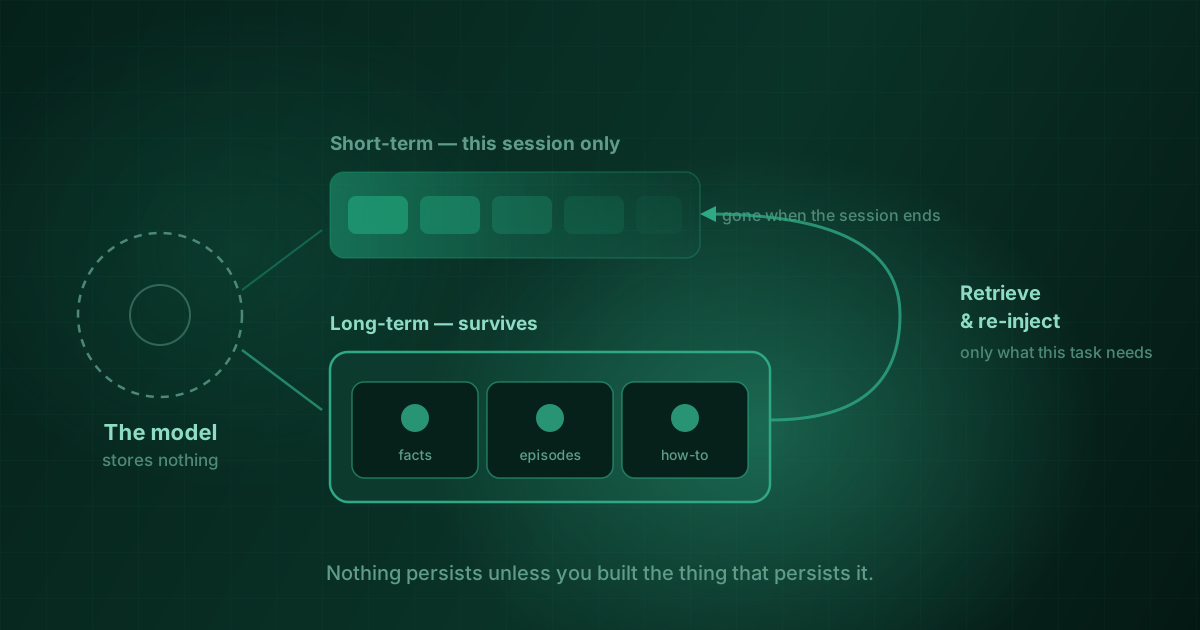
Short-term memory is working memory. The current conversation, the output of the tool that just ran, the reasoning in progress. It typically lives in the context window itself or a buffer just outside it, and it exists to keep the agent coherent right now. It also disappears when the session ends, which is correct — you do not want every stray remark from a debugging session to live forever.
Long-term memory is what survives. Facts about the user, decisions that were made, knowledge the agent accumulated. It lives outside the model entirely, usually in a real store — frequently a vector database, which is where the retrieval and embeddings machinery becomes relevant — and it has to be deliberately retrieved and put back into the context for the model to know anything about it.
The distinction earns its keep the moment something goes wrong. “The agent lost the thread halfway through a long conversation” is a short-term problem — a context window or buffer issue. “The agent does not know this customer complained last month” is a long-term problem — nothing was written down, or nothing retrieved it. Same symptom in the user’s words, completely different fix. Teams that have not made this distinction tend to apply the wrong one.
What production systems actually build
Here is where the mental model usually needs correcting. “Memory” in a real system is not a database you switch on. It is typically three or four different mechanisms doing different jobs, often on different storage underneath.
The taxonomy that has settled across the field splits long-term memory by what it holds:
- Semantic memory — facts and preferences. This customer is on the enterprise plan. This user wants terse answers. Stable, reusable, worth surfacing often.
- Episodic memory — what happened. We tried this approach in March and it failed for these reasons. Specific, timestamped, valuable precisely because it is particular.
- Procedural memory — how things get done here. The steps, the style, the conventions this task follows.
Several frameworks implement versions of this split — typed layers for recent interactions, longer-term learnings, and named entities or user preferences, each often backed by different storage. The point is not to endorse a particular one; this space is consolidating fast and today’s best choice ages badly. The point is that these are genuinely different problems. A fact should be overwritten when it changes. An episode should never be — it happened. Retrieval for “what does this user prefer” looks nothing like retrieval for “what did we try last quarter.” One store handling all of it handles all of it badly.
The bill nobody predicts
This is the part that rarely gets written about, probably because the companies best placed to explain it sell memory infrastructure and would rather lead with capability.
When an agent forgets, the fastest fix is obvious: put more history into the prompt. It works immediately, requires no architecture, and any engineer can ship it in an afternoon. So it is what most teams do.
The problem is what it does to the shape of your costs. Every request now carries the whole conversation. A ten-turn conversation sends turn one ten times. Cost and latency stop being roughly constant per request and start growing with conversation length — which means your most engaged users become your most expensive ones, and the feature gets more expensive precisely as it gets more successful. That is a genuinely bad shape for a business, and it usually surfaces as a confusing API bill months before anyone connects it to the memory decision made in week two.
A real memory architecture inverts it. Store the conversation once. Retrieve the handful of facts this particular task needs. Send a small, relevant context instead of an ever-growing transcript. The agent behaves better — irrelevant context makes answers worse, not just pricier — and cost stays roughly flat as usage deepens.
Memory is not RAG (and the confusion is expensive)
These get conflated constantly, partly because they often share a vector database, and the conflation leads to real architectural mistakes.
RAG retrieves from a fixed knowledge base you curated — your documentation, your policies, your product catalogue. It is a library. The agent reads from it, and the corpus does not change because of what the agent did.
Agent memory captures and evolves from the agent’s own experience — what this user said, what was tried, what worked. It is a diary. The agent writes to it, and it changes because of what happened.
Same shelves, different books. A system that has RAG but no memory can quote your refund policy perfectly and still have no idea this customer already asked twice. That is not a retrieval failure. It is a missing diary, and no amount of tuning the library will produce one.
Where this is heading — with a caveat
One emerging pattern is worth naming, clearly labelled as emerging rather than settled.
Beyond remembering facts, some systems are experimenting with agents that update their own operating instructions based on what worked — procedural memory that rewrites itself. An agent notices that a certain approach to a task consistently succeeds and amends its own guidance accordingly. Done well, that is an agent that genuinely improves with use rather than one that merely accumulates notes.
It is also genuinely bleeding-edge, and it should be treated that way. A system that edits its own instructions can drift somewhere you did not intend, and the same audit questions that apply to any autonomous behaviour apply here with force: what changed, when, why, and can you roll it back? Interesting direction. Not something to build a production roadmap on in 2026.
Where Macrosol fits
The useful conversation about memory almost never starts at “which memory product should we use.” It starts at what this agent actually needs to remember, for how long, and what it should be allowed to forget — because the honest answer is often much less than the most complete architecture would give you, and the difference shows up in both the bill and the quality of the answers. Our own internal marketing agent needs to remember brand conventions and what it has already produced; it emphatically does not need to remember every exchange forever, and building it as though it did would have made it slower, costlier, and worse. At Macrosol Technologies we help teams design the memory architecture that fits the actual use case rather than defaulting to the most complex option available, as part of our AI & Data Science practice.
The real question
“Why does it not remember?” has a boring answer: because nothing was built to make it remember. The model was never going to do that on its own, and the next one will not either.
The better question — the one that separates assistants people rely on from the ones they quietly stop opening — is what this agent genuinely needs to carry forward, and what it is better off letting go. Answer that precisely and the architecture follows: what to capture, where it lives, what retrieves it, what expires. Answer it vaguely and you end up with either an agent that forgets everything or one that remembers everything, and it is worth knowing that the second one is not the better failure. It is just the expensive one.