Multi-Agent Systems: More Agents Isn't a Strategy — Coordination Is the Whole Problem
Adding agents is easy — any framework will let you do it this afternoon. Deciding who decides, what happens when two agents disagree, and how you would reconstruct it later is the actual work.
There is a moment in most agent projects where someone suggests adding another agent. The first one is struggling with a task that turned out to be broader than expected, and a second agent — a specialist, a checker, a supervisor — feels like the obvious fix. Sometimes it is. More often it is the beginning of a system nobody can debug six months later.
Multi-agent systems genuinely outperform single agents on complex, multi-domain work, and the gap can be enormous. That part of the pitch is true and worth taking seriously. What the pitch skips is that the capability arrives bundled with a coordination and governance cost, and that the enterprises actually succeeding with multi-agent systems have converged on something far more conservative than the swarm of autonomous collaborators the marketing implies.
This is for the technical lead who has either outgrown a single agent or is being sold a multi-agent platform and wants an honest framework for whether it is the right call. If you have not built anything yet, start one step back — this piece assumes you have a reason to be here.
The real case for multiple agents
Start with the strongest evidence, because it is genuinely striking. Researchers at Huawei Noah’s Ark Lab built a collaborative multi-agent planning method and tested it on TravelPlanner, a benchmark of travel itineraries with stacked real-world constraints — budgets, dates, logistics that interact. Their approach averaged a 42.68% success rate. GPT-4 working alone scored 2.92%. The work was published at COLING 2025.
That is not a marginal improvement. It is the difference between a system that occasionally stumbles into a valid answer and one that usually produces a workable plan. When a problem decomposes into interdependent subtasks with constraints that have to be satisfied together, splitting the work across coordinated agents is not decoration — it is what makes the problem tractable at all.
The resolution is not that one camp is wrong. It is that task type matters more than agent count. Problems that decompose into parallel, constraint-bound subtasks reward coordination. Problems that need one long chain of reasoning punish it, because the chain keeps getting cut and re-summarized. Knowing which kind of problem you have is the entire architecture decision, and it is worth more than any framework choice you will make afterwards.
The pattern teams actually converge on
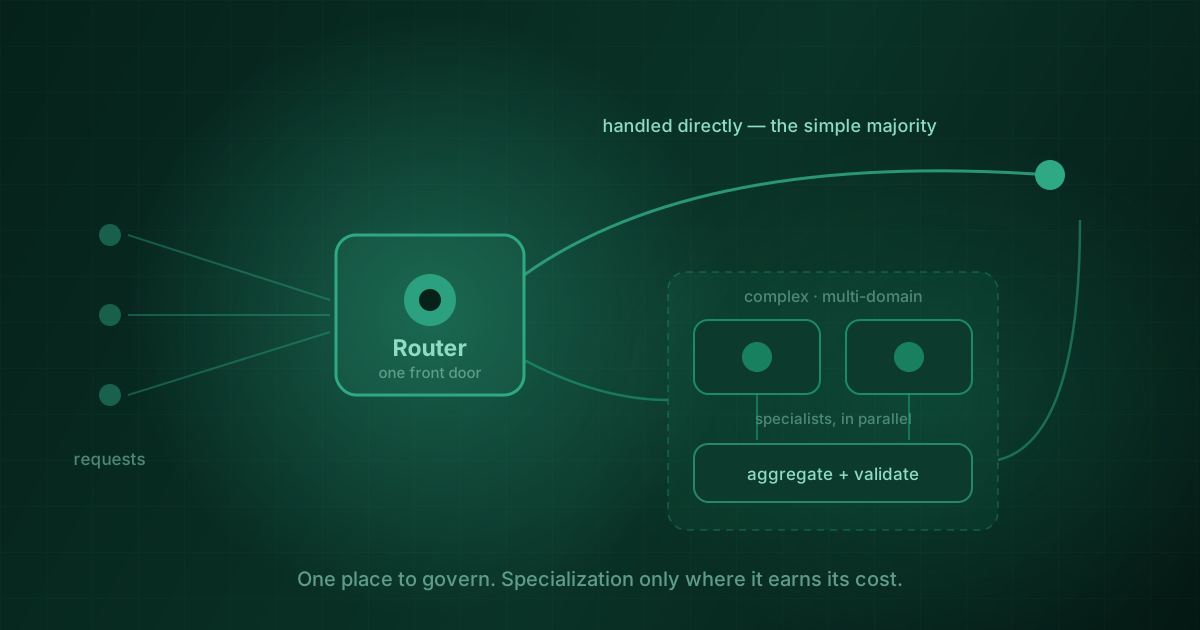
Here is the part worth the price of admission, because it is what mature teams build and it looks almost nothing like the marketing diagram. It is not a swarm of autonomous agents negotiating with each other. It is a single front door with specialists behind it.
Every request hits one lightweight router whose only job is to classify. The large majority of requests are simple, and the router handles them directly — no delegation, no handoff, no coordination cost. Only genuinely complex, multi-domain work fans out to specialist agents, and whatever they produce gets synthesized and checked before it goes back.
Salesforce documents this in Agentforce as a Supervisor agent acting as a single front door to specialists. Microsoft’s Azure architecture guidance describes the same shape as a router or orchestrator pattern. The vocabulary differs; the structure does not.
What makes it the de-risked choice is the combination it buys. You get one entry point to govern, log, and rate-limit — the governance simplicity of a single agent — alongside real specialization exactly where the work demands it. The complexity is contained behind the door rather than spread across your whole surface area.
One implementation detail matters more than it looks. The classifier should be small and fast, separate from whatever model does the real work — teams commonly run a lightweight model at intake and reserve the heavier model for the response. But the useful question is not which model classifies. It is what you train the routing on. The best signal is the failure log of a single-agent baseline you actually ran: the cases where one agent visibly struggled are, precisely, the cases worth routing elsewhere. Skip the baseline and you are routing on intuition.
A worked example: fraud review
Abstractions get slippery here, so take a concrete one. A fraud-detection workflow on a flagged transaction:
- A transaction agent examines the transaction itself — amount, merchant, location, timing, how it compares to normal patterns for this account.
- A history agent looks at the customer instead — tenure, past disputes, recent changes to the account, whether this looks like them.
- An aggregator takes both readings and synthesizes them into one assessment, which is real work: the two agents will sometimes disagree, and the disagreement is often the most informative signal available.
- A validator checks the result before it leaves — is the conclusion supported by what was actually found, does it satisfy policy, does it need a human.
Notice why this decomposes cleanly. The two analysis agents genuinely need different data, different tools, and different expertise; they can run at the same time; and neither needs to wait on the other. That is the shape that rewards coordination. Notice also that two of the four roles — aggregator and validator — exist purely to manage the fact that you split the work. That overhead is the tax, and it is why splitting a problem that did not need splitting makes things worse rather than better.
Governance is not the boring part. It is the part that decides.
This section gets cut for length in most articles. It should not be, because it is where multi-agent systems actually fail — and it maps directly onto Gartner’s finding that over 40% of agentic AI projects will be canceled by 2027 over costs, unclear value, and inadequate risk controls.
With one agent, an incident means reading one trace. With five, it means reconstructing a conversation — who decided what, on what information, and which of them was working from a summary that had already dropped the detail that mattered. If that record does not exist, you are not investigating an incident. You are guessing about one.
So the requirements are unglamorous and non-negotiable. Centralized oversight— one place that knows what the whole system is doing, not five dashboards. Per-action audit trails — which agent invoked which tool, with what arguments, against what data, and what came back. And both of them built into the development workflow from day one, not bolted on after the first thing goes wrong. Retrofitting audit onto a live multi-agent system is dramatically harder than building it in, for the same reason retrofitting an access layer under a live integration is: everything already depends on it working the way it works.
This is the same discipline that exposing systems to a model demands, pointed at a different problem. More agents means more actors, and every actor needs to be accountable individually.
Are you actually ready
Five signals, and they should be observations from a system you are running rather than predictions about one you are planning:
- Cross-domain workflows. The work spans three or more domains that each have their own tools, their own data, and their own definition of a good answer.
- Genuine parallelism. Independent subtasks exist and running them concurrently is the point — not a theoretical nicety you would never actually notice.
- Compliance boundaries. You need separate audit trails per function, or permissions that must not sit in the same agent — the component that reads customer records should not be the one that can issue a refund.
- Context that will not fit. The full workflow needs more context than one window holds, and you have already tried a real memory architecture rather than stuffing history into the prompt.
- Documented single-agent failure. You can point to specific, logged cases where one agent failed for structural reasons — not because its brief was vague.
That last one carries the most weight, and it is the one most often skipped. If a single agent is failing because nobody defined success, or because its tools are unreliable, splitting it into four agents will reproduce every one of those problems and add coordination overhead on top. Adding agents does not fix an unclear brief. It multiplies it.
Where Macrosol fits
The work we find most useful for clients is rarely “build us a multi-agent system.” It is the architecture decision that comes first: single, multi, or the hybrid front-door pattern — and what evidence would actually settle it. That means being willing to conclude that one agent is enough, which is not a conclusion a vendor selling orchestration is well placed to reach. Our own internal marketing agent is deliberately single-agent for exactly this reason: we have not yet seen it fail in a way that specialization would fix. When it does, the logs will tell us what to split and where to route, and we will have the baseline that makes the routing decision an engineering judgement rather than a guess. That thinking sits alongside our AI & Data Science practice.
Coordination is the whole problem
Adding agents is easy. Any framework will let you do it this afternoon. What is hard is deciding who decides, what happens when two agents disagree, how work gets handed off without losing the detail that mattered, who is accountable when the answer is wrong, and how you would reconstruct any of it a week later.
Those questions do not have framework answers. They have design answers, and they are the actual work — which is why “more agents” was never a strategy. The teams getting real value from multi-agent systems in 2026 are not the ones with the most agents. They are the ones who knew which kind of problem they had, kept one front door, contained the complexity behind it, and could prove what happened. Start there, and the architecture mostly designs itself.