Self-Healing CI/CD: Your Pipeline Used to Follow a Script. Now It Can Reason About What Went Wrong.
The 2 AM failure is never interesting — the fix takes ninety seconds. What cost you was being woken up. Here is how much autonomy is actually safe to grant, sorted by risk.
Every DevOps engineer knows the 2 AM version of this. The pipeline fails. The failure is not interesting — a transient network error, a dependency that moved, a flaky test that flaked. The fix takes ninety seconds. The part that cost you was being woken up to perform it.
Your pipeline could not do it because your pipeline cannot think. It executes a script. When reality matches the script, it works beautifully; when it does not, it stops and finds a human. That determinism is a feature — it is why CI/CD is trustworthy — and it is also why the boring failures cost as much attention as the interesting ones.
What is changing is that a pipeline can now interpret a failure, gather context, decide on a fix, and retry — inside boundaries you set. The honest version of this story is not “pipelines that need no oversight.” It is pipelines that escalate less often, and escalate more usefully when they do. That is a smaller claim than the marketing makes, and a much better one.
What is actually new here
Cut through the vocabulary first, because “agentic” is doing a lot of unearned work in this market. If you want the broader picture of what agentic means in delivery, we cover that separately. For the pipeline specifically, one distinction matters:
Traditional automation executes a task. Run these steps. If step four fails, stop and report. It cannot do anything else, because nothing else was written down.
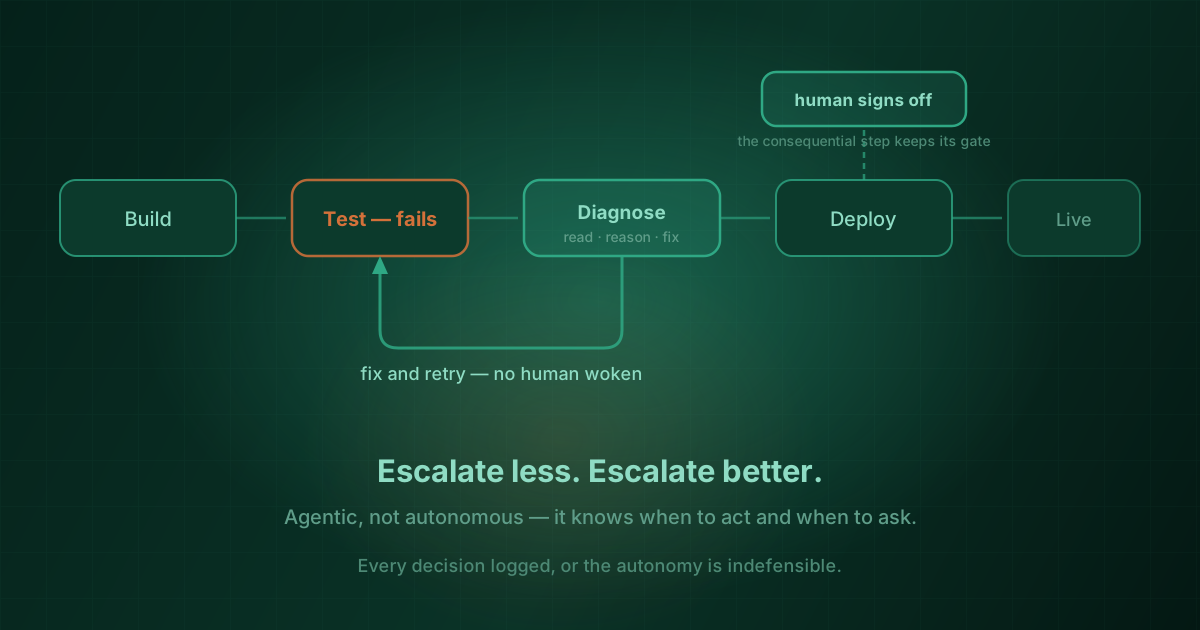
An agentic pipeline pursues a goal. Get this change tested and deployed. If step four fails, work out why: read the log, look at what changed, form a hypothesis, act on it, check whether it worked. If not, try something else — or escalate, with the diagnosis attached.
That is the entire difference, and it is worth sitting with, because it explains both the upside and every risk that follows. You have replaced a system that does exactly what you wrote with a system that does what it judges best toward an outcome you specified. That is more capable and strictly less predictable, and pretending otherwise is how teams get hurt.
Where it genuinely works today
Ignore the demos and look at what teams actually run. Three clusters have real traction, and the thing they have in common is more instructive than the list.
- Incident triage. An alert fires. Before a human opens a laptop, an agent has read the alert, pulled the relevant logs, checked what deployed recently, walked the dependency graph, and written a short summary of the two or three most likely causes with the matching runbook. It has not fixed anything. It has removed the twenty minutes of gathering that stands between “alert fired” and “I know what I am looking at.”
- Predictive test selection. Rather than running a forty-minute suite on a change that touched one module, run the tests actually likely to catch a defect in this diff. Pipeline time drops substantially. The risk — missing a defect the skipped tests would have caught — is real and is exactly why this pairs with a full suite on a schedule rather than replacing it.
- Self-correcting build fixes. The build fails on a missing dependency. An agent reads the error, checks the manifest, sees the omission, adds it, and opens a fix. Routine, mechanical, and precisely the work that should never have needed a person.
The real question: how much autonomy, for what
This is the part most content skips, and it is the only part that determines whether any of this is safe to run.
“Should the pipeline act on its own?” is the wrong question because it has no single answer. Deploying a copy change to a static site and rotating a production database credential are not the same act and should not share a policy. The teams seeing real gains do not turn autonomy up. They sort changes by risk and set a different rule per tier.
Routine and reversible — the agent proceeds. Low-risk deployments, easily rolled back, small blast radius. No human in the path. This is where the time comes back, and it is most of your changes.
Consequential — a human signs off. Production, customer data, permissions, anything with an irreversible edge. The agent still does the work: it prepares the change, explains its reasoning, shows what it will touch. Then it stops and waits. You are not reviewing a blank form; you are reviewing a proposal. That is faster than doing it yourself and slower than letting it fly, which is the correct trade for this tier.
Rollback — automatic, but only on a clear signal. This is the tier teams get wrong. Automatic rollback is genuinely valuable and genuinely dangerous: rolling back on an ambiguous signal can be worse than the original fault, especially if the rollback itself has side effects. The condition is not “something looks bad.” It is the signal is unambiguous and the blast radius is known. If you cannot state both precisely, that rollback should page someone instead.
The useful property of this framing is that the tier a change falls into is a decision you make once, in advance, deliberately — not one the agent makes in the moment under pressure.
Early results, honestly framed
The numbers in this space are early and mostly come from parties with an interest, so hold them loosely.
Microsoft’s Triangle system reports 97% triage accuracy and a 91% reduction in time-to-engage on Azure incidents. Uber’s Genie copilot is credited with saving roughly 13,000 engineering hours since late 2023. More broadly, teams deploying AI agents for incident response report MTTR reductions around 40%.
Read where those gains land: detection and triage, not fixing. The bottleneck being removed is the gap between “alert fired” and “I know what is wrong” — which, if you have ever been on call, is where the time actually goes. That is a real win and a narrower one than “AI resolves your incidents.”
Treat these as early results from specific deployments by well-resourced teams, not a promise. Your pipeline is not Azure’s.
Log the reasoning, not just the action
There is a tradeoff at the centre of this that is easy to state and easy to ignore: the more autonomy an agent has to accelerate delivery, the more tightly its actions have to be logged and reviewable — because a faster mistake is still a mistake, it just arrives sooner.
Your existing pipeline logs are not enough. They tell you what ran. For an agentic pipeline you need what it decided and why: what it observed, what it concluded, what it chose to do, what happened, what it did next. Six weeks later, when someone asks why a configuration changed on a Tuesday night, “the agent did it” is not an answer that survives an audit or a post-mortem.
How it goes wrong
Three failure modes, named plainly, because a pitch that omits them is not describing a system anyone has actually run.
Plausible-but-wrong fixes. The agent diagnoses confidently and incorrectly. It suppresses the failing assertion instead of fixing the bug, or pins a dependency to an old version to dodge an incompatibility it did not understand. CI goes green. The problem is still there, now with a commit message explaining that it was solved. This is the most dangerous failure because it looks exactly like success.
Repeated failed actions. The agent retries variations of an approach that was never going to work, burning minutes and CI spend. This is a real-world instance of a general problem — agent tool calls compound errors across steps, and a pipeline is a long chain of tool calls wearing a YAML hat.
Run-to-run inconsistency. The same failure, handled two different ways on two different days. This is the one that unsettles good engineers most, and they are right to be unsettled: the entire historical value of CI/CD was that it did the same thing every time. You have traded some of that determinism for adaptability. That is a defensible trade — but it is a trade, and it should be made on purpose rather than discovered.
Read those three back and notice they are precisely why the staged tiers and the audit log are not optional extras. They are the containment.
Where Macrosol fits
The interesting work here is almost never the agent. It is drawing the boundaries: which changes are routine enough to proceed unattended, which need a human at the gate, what signal is unambiguous enough to justify an automatic rollback, and what has to be logged for any of it to be defensible six months later. Those lines are specific to your environment, your risk appetite, and your regulator — and getting them wrong in either direction costs you, whether that is an incident or an expensive pipeline nobody trusts enough to use. Macrosol Technologies helps teams design that staged-automation boundary and the observability layer underneath it, as part of our DevOps & Cloud Native practice.
Escalate less, and escalate better
The version of this story that sells is a pipeline that runs itself. The version that is true is more modest and more useful: a pipeline that handles the boring failures without you, asks before it does anything consequential, and hands you a diagnosis instead of a stack trace when it genuinely needs you.
That is not a lesser outcome. Most of what wakes engineers up is not hard — it is just unattended. Removing the routine interruptions while keeping a human at every decision that could actually hurt is the whole win, and it is available now. The teams that get there will be the ones who decided their risk tiers deliberately rather than discovering them during an incident — and who can still explain, months later, exactly what their pipeline did and why. What that pipeline deploys into is the next problem down.